Ideation
Brainstorming Process
For the brainstorming method we wrote our ideas on colorful paper squares in an anonymized round-robin fashion, which made the process very engaging for everyone and allowed all members to contribute a large quantity of ideas, without fear of judgement for "bad ideas". We found this method worked very well in terms of idea generation, and also was great fun for all participants. In order to get inspired before each of the six ideas-generation rounds, we read a couple of user / "how might we" needs out loud, but also emphasized that these prompts only served for voluntary inspiration; any idea not related to the prompt could be submitted. We introduced this strategy because some members felt overwhelmed with the prospect of generating six ideas "out of thin air". Judging by the team atmosphere during this process and by the impressive results, we felt that this approach worked very well.
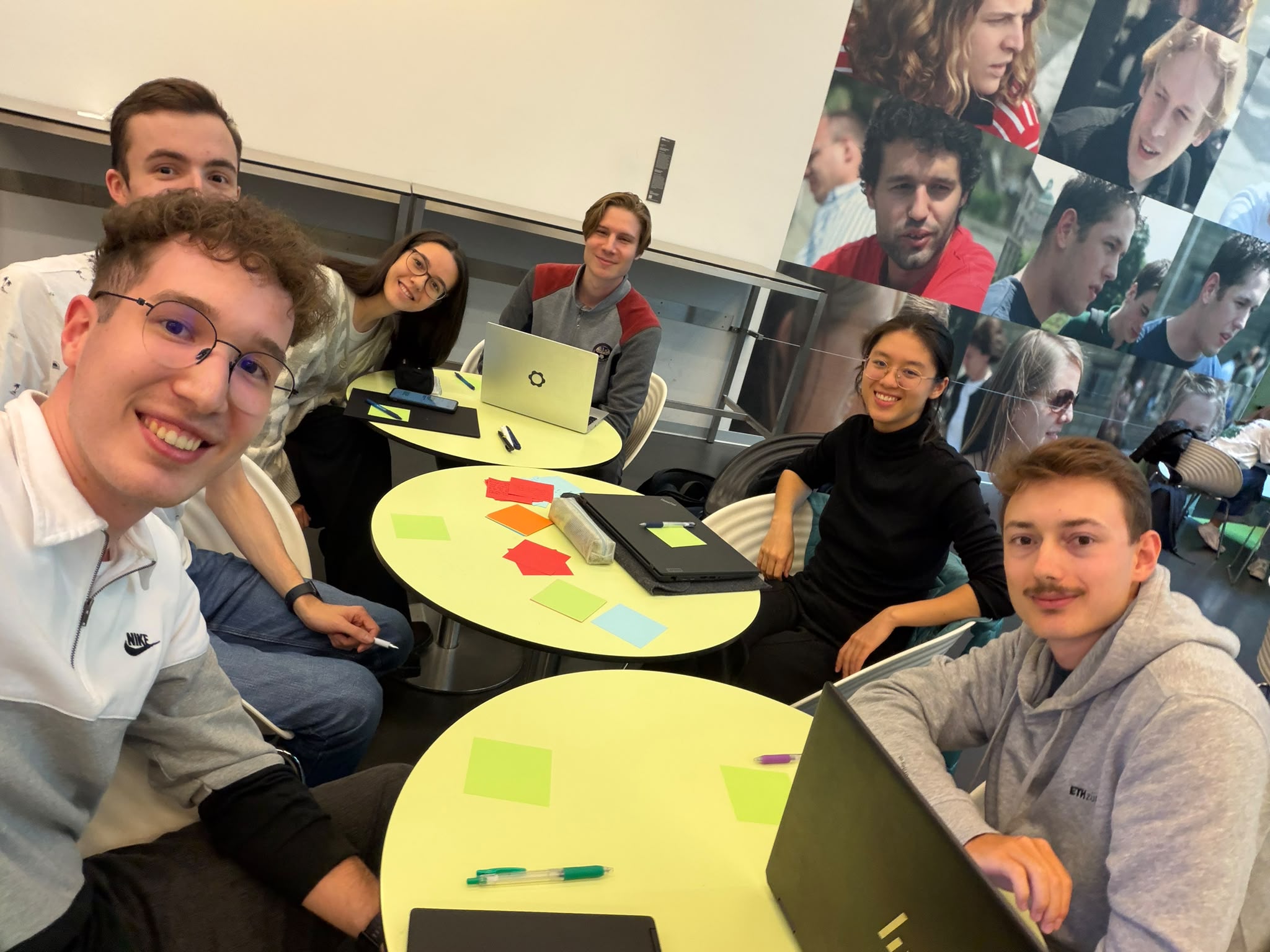
Additionally, after all generated ideas were presented to the group in an anonymized manner (the person reading out load was not able to match handwriting to individuals of the group), some group members felt further inspired by the proposed ideas and contributed even more ideas in an unofficial seventh round. This indicates that some ideas were easy to build upon, so in future it would also be interesting to use the other brainstorming method which builds on previous ideas.
Affinity Diagram
Since we used paper pieces to record our ideas, constructing the affinity diagram was a very intuitive process of grouping and spatially relating similar themes and goals. We included pieces of paper in a distinguishing color (yellow) to describe use cases inspired by our "How might we" prompts. We thought that writing out specific user needs will help us maintain a user-focused mindset when grouping our ideas. In particular, we were surprised by how many "synergies" we found across thematic clusters: ideas that were unrelated in their motivation, but so similar in functionality, that they could be combined to enhance the benefits of all original ideas. This is described using concrete examples in the actual report, but it should be noted here that this was a very high-motivation moment for the team that pooled into two Lo-Fi Prototype ideas quite naturally. The only avenue for improvement is access to more slips of paper, since we ran in some of the categories. Alternatively, we could have used FigJam on Figma, which allows doing the same kind of prototyping, but digitally. We do however believe that going the analog route has contributed to the overall effectiveness of the brainstorming session.
The influence of our field research to both the ideas collection and the selection/combination of features for the prototypes was subtle, due to the fact that during brainstorming we had not yet shared the findings of each team members two pieces of related work. Although this was not done on purpose, looking back we think it may have helped us keep diverse mindsets and generate different ideas, since everyone had researched something different ahead of time. In addition, it could have prevented bias towards commonly implemented solutions by either not being able to separate from those ideas, or trying to hard to move away from the convention. In hindsight, we are very satisfied with the impression that the field research on successful design choices for studying with AI aligns with our need finding results, but also that our proposed solutions go beyond what commercial products offer.